“This Really Isn’t Our Fight and It Will Cost Us”: Behind the Scenes of CBC Support for Bell’s Website Blocking Plan
Bell’s behind-the-scenes effort to drum up support for its site blocking proposal at the CRTC has been the subject of several posts over the past few months. Based primarily access-to-information requests, I’ve identified Bell pressure on universities and colleges such as Ryerson University, George Brown College, and Brock University, who all submitted support letters to the CRTC, though those letters were not always quite what they seemed (Brock University quickly distanced itself from the submission, the Dean behind the Ryerson letter advised Bell that he could not speak for the faculty). Earlier posts also highlighted Bell’s astroturfing campaign with its own employees and its undisclosed meetings with CRTC officials months before the proposal was made public.
This post adds one more piece to the puzzle: how did Bell work to convince other companies to join its coalition? For that answer, I filed an access-to-information request with the CBC, the only coalition member subject to those laws. CBC’s participation in the site blocking coalition was always an outlier. I noted in a post on its participation that:
CBC may justify its support for site blocking as a matter of principle, but in doing so it jettisoned other important principles that Canadians might have expected their public broadcaster to support. By adopting a position that it would prioritize blocking Canadians who try to access its programming, the CBC is outlier when compared to other public broadcasters who have worked to overcome blocking mandates around the world.
In fact, it turns out that concerns with the CBC’s participation was shared by some involved in the decision-making process. For example, CBC’s Executive Director of Public Affairs and Government Relations, commenting in a heavily redacted email string, plainly advises CBC’s Vice-President, Strategy and Public Affairs, that “this really isn’t our fight, and it will cost us.”

Poulter email, obtained under ATIP
The executive also described the coalition as the “Bell anti-piracy project” in an email update to CBC President and CEO Hubert Lacroix two weeks before the formal filing at the CRTC.
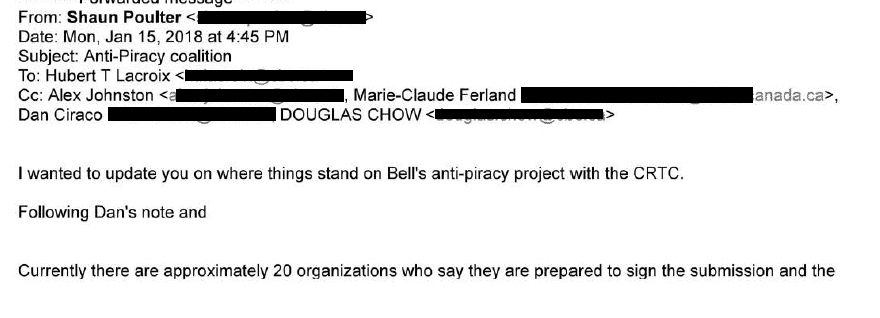
Bell anti-piracy project, obtained under ATIP
The records obtained from the CBC are heavily redacted with thousands of responsive pages left largely blank due to a myriad of exceptions for legal advice and commercially sensitive information. However, the records do provide several hints at how things unfolded. First, Bell approached potential participants in the summer of 2017, around the same time as it was working to secure an advanced meeting with the CRTC. An email request went to Heather Conway, CBC’s Executive Vice-President, English services, with responsibility for all English-language services, on July 19, 2017.
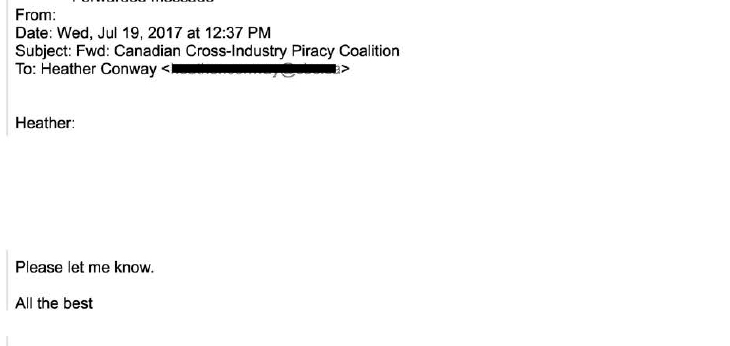
Conway invite, obtained under ATIP
Conway forwarded with message to CBC’s Executive Director of Business & Rights and Content Optimization with the suggestion that executives from digital operations and government relations also participate. That quickly led to an introductory call and a broader meeting with additional CBC personnel. The meeting was not limited to Bell as one email identifies Rogers’ Chief Legal Officer as one of the participants at the same meeting.
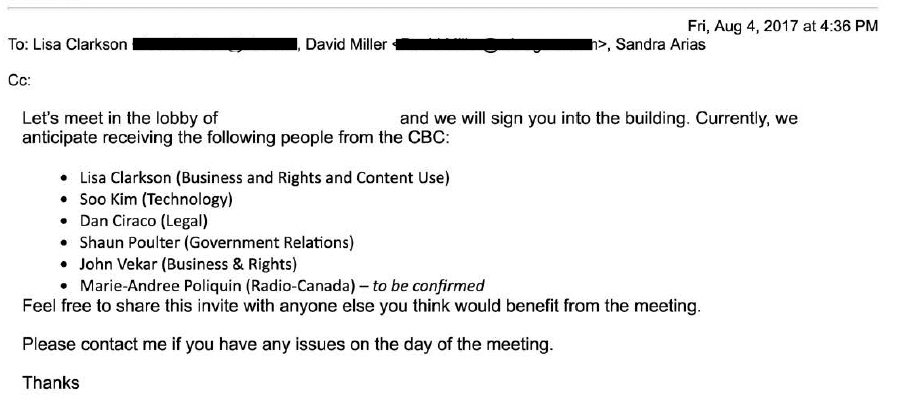
August meeting, obtained under ATIP
Over the months that followed, CBC held additional meetings and began to develop its internal position on the issue with regular correspondence with Bell (there is heavy redaction but some emails include Bell contact information or references to being at the company). Senior CBC management, including President and CEO Hubert Lacroix, were often included in the correspondence and were well aware of the issues associated with the site blocking proposal. Moreover, the CBC participated in monthly Skype-based meetings among all participants organized by Bell to advance the proposal.
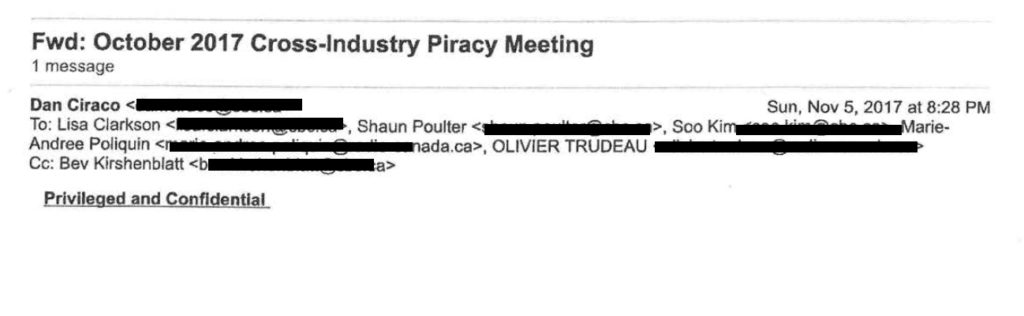
Cross industry meeting, obtained under ATIP
Once the potential filing came closer in December 2017, the CBC developed a Q & A document that sought to justify the participation. Consistent with the leak that led to a story in Canadaland and resulting media coverage, the focus of the media lines was on the proposed “Internet Piracy Review Agency.” Those media lines would resurface once the filing formally occurred in January 2018. The CBC has remained largely silent since the filing, responding only the occasional media request for comment.
The CBC’s participation was always difficult to reconcile with the public broadcaster support around the world for net neutrality, media freedom, and public access. Further, the CBC might prefer that viewers use authorized services, but supporting blocking is a counter-intuitive position for a public broadcaster as it tries to stop Canadians from viewing the content they paid for through their tax dollars. Internal documents now suggest that executives at the highest level were involved in the process from the very beginning and well aware of the concerns.
The post “This Really Isn’t Our Fight and It Will Cost Us”: Behind the Scenes of CBC Support for Bell’s Website Blocking Plan appeared first on Michael Geist.
Comments
Post a Comment